

Like the style? Explore the designs featured below ↓
In 2023, a civilian air-surveillance radar in the western United States registered eight detections over 84 seconds. An Air Force interceptor did not have to chase anything for that event to become a headline. All it took was a line of arithmetic. Connect the detections as one continuous track and the result is roughly 38.5 miles in a minute and 24 seconds, or about 1,650 miles per hour. The public did not get that estimate until November 20, 2026, when the Pentagon released another batch of UFO records. By then, the number was ready to travel faster than any object the radar might have seen.
The file is called DOW-UAP-D165. Its most consequential statement is the caveat that the available evidence cannot independently establish that all eight detections came from the same object. If they did, the speed estimate is worth serious attention. If the association fails, the headline speed may describe a line an analyst drew between returns from different sources. Both possibilities survive the same document. Even the government’s best public language for this one is unresolved. D165 case index and original file link
That is the reason to look closer. Seventy-four years earlier, radar returns near Washington, D.C., put flying saucers on front pages and a curious question on the CIA’s desk. How much of an apparent flight belongs to something in the sky, and how much belongs to the instrument, the conditions, and the people connecting the dots? This latest file gives us a chance to watch that question come back in a particularly unforgiving form. Eight detections. One proposed track. A conclusion that changes completely if even part of the chain breaks.
What was released on November 20
The November 20 publication was the eighth batch in the U.S. government’s PURSUE effort, the Presidential Unsealing and Reporting System for UAP Encounters. UAP stands for unidentified anomalous phenomena. Older files may call related reports flying saucers or unidentified flying objects. The naming has changed, and the agencies and reporting processes have changed with it. For this story, the important continuity is that a label for a report does not identify its cause. Official PURSUE archive · November 20 release chronology
A release date records when a document or clip entered this publication program. An incident date records when the underlying observation took place, as far as the source can establish it. An analyst might then evaluate that observation years later. Documents from different decades can arrive on one Friday, presented next to each other in one search interface. That proximity tells you when the files became accessible through this collection. It says little about whether their subjects shared an origin. One folder can contain a sighting, a later assessment, and an older file included for historical context without turning them into three independent observations.
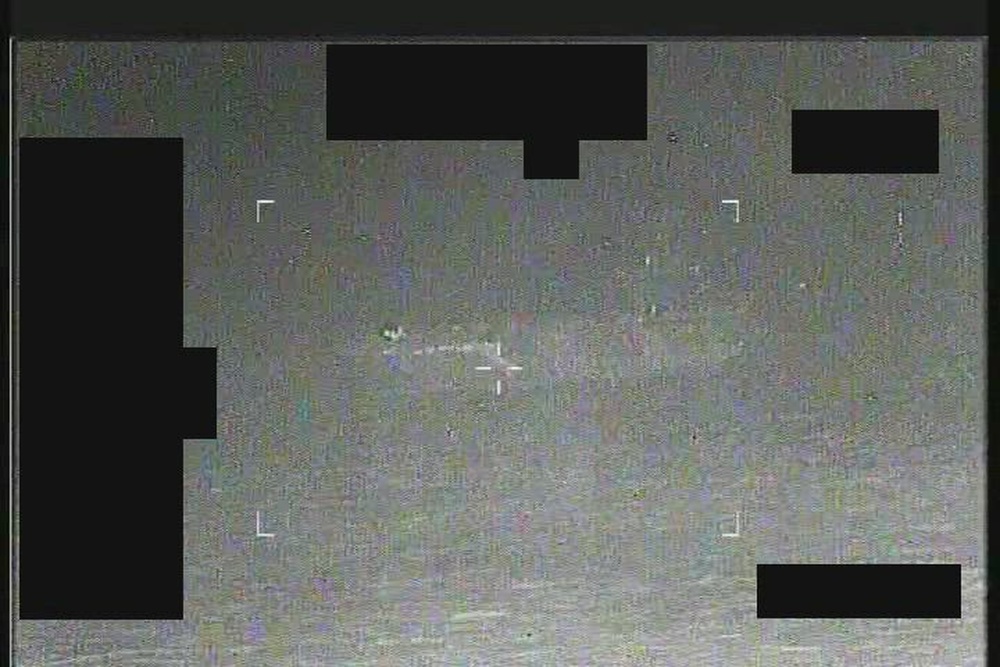
Two release records make the difference concrete. D165 is a preliminary analysis slide concerning civilian radar detections in 2023. PR166 is a separate military infrared clip from 2020 that was posted to the Defense Visual Information Distribution Service on November 20, 2026. People sometimes share an intriguing video alongside a newer radar claim as if the picture illustrates the same event. These two records have different dates, different settings, and different instruments. The authentic frame below belongs to PR166. D165’s original slide supplies the numbers and qualifications discussed in this article. Read the linked scan to compare the map legend with the headline. D165 preliminary analysis · PR166 video record
The published materials are a reason to reopen questions about specific cases. There is no scientific benefit in counting every item in the release as a separate mystery, especially if one incident generated several documents. A new cover sheet, a copy sent to another office, and an assessment can all be significant records. Only the underlying observations add sightings. This distinction matters when a viral post substitutes the size of a document release for the quality of the evidence in it.
The eight returns and the estimate they produced
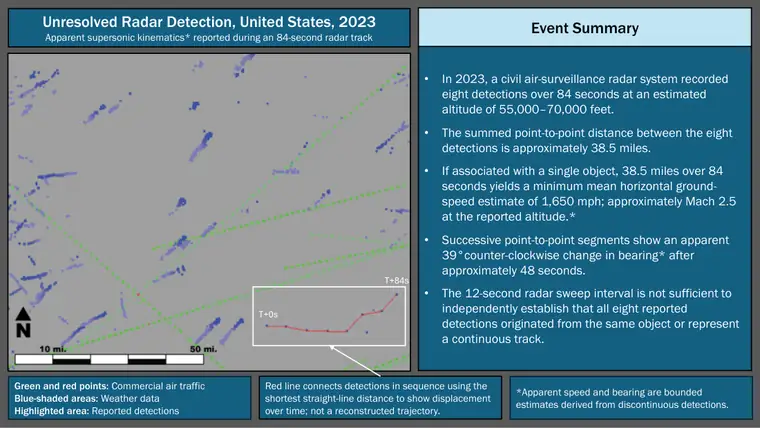
The slide’s map supplies a detail that changes how you read the image. The red line shows straight segments connecting the detections in order. It represents the displacement used for the estimate. The government explicitly distinguishes that line from a reconstructed trajectory. The other colored marks give context about commercial traffic and weather. You can see where the authors drew the boundary between what they could illustrate and what the instrument record could establish. Original D165 slide, mirrored PDF
D165 describes a particular amount of information. A civil air-surveillance radar system registered eight detections over 84 seconds in the western United States. The estimated altitude range was 55,000 to 70,000 feet. Under the assumption that the detections form one continuous track, the reported cumulative point-to-point distance is about 38.5 miles, corresponding to a minimum mean horizontal ground-speed estimate around 1,650 mph. The segments also suggest a 39-degree change in bearing after roughly 48 seconds. The slide says the evidence is insufficient for a comprehensive description of the motion. D165 preliminary analysis
The arithmetic checks out at the level the rounded inputs let us see. Divide 38.5 miles by 84 seconds, then multiply by 3,600 seconds per hour. The result is 1,650 miles per hour. The neat agreement is satisfying, but it verifies the arithmetic, not the interpretation. You can calculate a speed from numbers describing any sequence of positions. To call that number the speed of an object, the sequence must belong to the object. That is the hard part of this case, and the public summary explicitly preserves the problem.
Imagine watching a parking lot from a window for a second at a time. At 9:00 you notice a dark car by the entrance. At 9:01 another dark car appears beside the loading bay. If both glimpses belong to the same car, dividing the distance by the minute gives you a rough average. If the second car had been parked there before you looked, the calculation still returns a number. Neither car needs to have driven the line you imagined. Radar and visual observation gather information in different ways, but the logic of assigning separated observations to one subject holds in both cases.
An analyst can make that assignment more plausible by asking whether the spacing, timing, altitude estimates, and probable motion agree. More observations can narrow the alternatives. Yet even a tidy plot deserves a separate question about the rules used to select the dots displayed on it. If some returns are omitted because they do not fit the proposed track, the remaining pattern can look cleaner than the full data. I am not saying that happened in D165. The point is that a public summary of eight selected detections cannot let a reader test every choice an analyst might face when building and comparing tracks. To do that, the public would need the fuller record and its processing history.
The advertised round number also needs its unit and reference point. This is described as horizontal ground speed. Ground speed is movement over the ground. Airspeed is movement relative to the surrounding air. Mach is a ratio to the local speed of sound, which depends on atmospheric conditions, particularly temperature. A Mach label in a headline can put the scale in familiar terms, but it does not add a new sensor measurement to the file. Nor does the report’s mean speed tell us what happened at any particular instant between detections. D165 record and estimate
A change in bearing is a much smaller claim than an impossible turn
The second number that deserves attention is 39 degrees. If all the returns belong to one target, successive segments appear to point in different directions. That difference can be worth studying without providing a frame-by-frame record of how the target moved. A line drawn from point A to point B gives the overall direction between them. It cannot tell you whether the subject traced a smooth curve, changed course abruptly, or followed some other path through the interval.
Picture three locations in a city on a simplified map. The line from the first to the second points northeast. The line from the second to the third points east. A cyclist moving through the three positions might have ridden a curved street with a gradual bend. They might have come nearly to a stop at a corner and then turned. The orientation of the lines does not tell you which. Your result becomes more uncertain if the three positions were estimated with sizable error bars. A small shift in where one dot is drawn can rotate both adjacent lines at once.
For an extraordinary maneuver claim, you would want a time scale and better positional resolution. How long did the change take? What was the estimated speed at the beginning and end of the interval? Were the points accurate enough to distinguish a turn from position uncertainty? If the first and second part of the sequence belonged to different targets, there might be no turn to explain at all. In this case, even the word apparent earns its place. It ties the angle to the constructed sequence rather than an observed continuous maneuver. D165 report summary and document link
The importance of that distinction becomes clear when a social post upgrades the angle into an assertion about g-forces. Acceleration depends on how quickly velocity changes. A change in direction means a change in velocity if a physical object followed the proposed path, but the rate depends on what happened between samples. Without that interval and reliable motion estimates, a number for acceleration would add precision the evidence never provided. It might look like a quantitative analysis because it contains a formula. The missing quantity would still be missing.
Why eight detections are meaningful and still leave room for doubt
It would be easy to reduce the discussion to two unsatisfactory options. Either the radar worked, so the headline is true, or something was wrong with the radar, so the case is boring. The reality is richer. A radar system can function normally, detect real signals, and yield a set of observations that have more than one plausible interpretation. The chain from returned energy to a named object contains several steps, each with its own uncertainty.
The original slide gives a 12-second radar sweep interval and says that interval is insufficient to establish that the detections came from one object or represented one continuous track. The 84-second span contains seven intervals of that length. The sweep interval describes the radar’s opportunities to sample the scene. The public slide does not provide all the underlying time stamps or raw returns. Every gap is an interval in which this public reconstruction has no intermediate point. Those intervals can leave room for a faster or slower curve, an intermittent return, a change in what was detected, or simple ambiguity about the source. Readers can understand that uncertainty without knowing the radar’s sensitive operating specifications.
Another useful distinction is between the estimated altitude of a detected return and physical properties of an identified aircraft. The quoted 55,000–70,000-foot band is part of the case summary. The available account does not provide enough public material to reconstruct every altitude estimate and its error on our own. There is a difference between taking the estimate seriously and treating its endpoints like precisely surveyed heights. Likewise, it matters whether a system reports a geographic position directly, estimates it through a track processor, or combines it with other information. The output will look like a set of coordinates either way, even though the path to those coordinates differs.
The file is consequential precisely because a civil surveillance system was involved. Instrument observations matter, and reports of unexpected behavior in monitored airspace deserve careful triage. An unresolved observation can justify improving collection, comparing logs, or referring an event to another group. It does not follow that this particular return proves a breach of restricted airspace, a threat, or the presence of a specific vehicle. On this point the case is a good miniature of the larger problem. Reporting something unusual can be the correct operational decision well before identifying it is possible.
The summer Washington had a radar mystery of its own
In July 1952, during a surge of flying-saucer reports, radar scopes at Washington National Airport and Andrews Air Force Base registered unusual returns. The CIA’s later historical account describes returns on July 19 and 20 and another episode on July 27. The Air Force scrambled interceptors to investigate. The episode attracted national attention, including interest from the White House. A July 29 CIA memorandum records that recent radar and visual reports prompted an internal study group to review the subject. CIA historical account · CIA memorandum scan
This was a genuinely unsettled moment for people asked to explain unexpected reports. Cold War air defense made unexpected tracks matter even if they ended up having ordinary causes. An intelligence office could ask whether the country was seeing a foreign development, a reporting problem, or something with no immediate explanation. A newspaper and an intelligence analyst had different reasons to be interested in the same returns. Understanding those incentives gives the documents more texture than reading every classification mark as the answer to a single mystery.
An explanation under discussion involved temperature inversions. Under an inversion, temperature increases with height through a layer rather than decreasing as it ordinarily does there. Changes in how the atmosphere is layered can bend radar energy away from the path assumed under more typical conditions. In some circumstances this lets a system receive echoes from locations a reader of the display would not expect. The CIA’s historical account describes subsequent civil aviation work finding that conditions of this kind could produce radar effects of the sort being discussed. That makes atmospheric propagation a real line of investigation. It does not tell us, seven decades later, which mechanism produced each individual 1952 return. CIA history of UFO investigations
There is an emotional reason the 1952 story still works. For most people, the word radar sounds more decisive than someone saying they saw a light. Radar can measure important things observers cannot. It can also present an interpretation on a screen whose meaning depends on how an instrument deals with range, reflections, and the atmosphere. The correct response to uncertainty is to seek better instrument evidence and examine it more closely. Dismissing the instrument and blindly believing the display throw away the same opportunity to learn.
The connection to 2023 is methodological. The cases are separated by decades, geography, and unknown differences in collection conditions. The July events give us a precedent for an institution needing to learn the behavior of its own observations. They do not give us a weather report for the day D165 was recorded. An explanation for a radar episode in Washington cannot be imported into a western U.S. case merely because both narratives contain the word radar. Accounts that rush to an ordinary explanation and accounts that rush to an exotic one can both make precisely this mistake.
The panel that disagreed with the people analyzing the film
The CIA convened a scientific panel chaired by physicist H. P. Robertson in January 1953. One of the cases it reviewed involved a 1952 film taken near Tremonton, Utah. The people in the car had reported a cluster of bright objects. Analysts from a Navy photographic laboratory studied the film and thought familiar candidates had been ruled out. The panel disagreed that the footage required the objects to be emitting their own light and believed an ordinary explanation could be tested with a controlled experiment. CIA account of the Robertson Panel and Tremonton film
This is the historical passage I would put in front of anyone who thinks an old UFO document can be settled by pointing to the highest-ranking person mentioned in it. The panel and the lab were looking at the same underlying film. They did not disagree on whether the footage existed. They disagreed about what optical properties could be extracted from it and what had actually been excluded. The institutional record is valuable because it preserves competing interpretations alongside a description of the material that prompted them. A dramatic excerpt can erase that argument in a sentence.
A good question for the Tremonton discussion is what the camera would have recorded under a similar geometry if daylight reflected from a known target. A useful test would give the analysts something they could compare to the observed brightness and motion, with similar camera settings if those were known. It might narrow an explanation. It might reveal differences that needed more study. Even a well-designed test should state which aspects of the footage it can reproduce and which remain unexplained. That level of specificity is what makes a claim testable instead of merely persuasive.
Also look for the same kind of careful separation when old reports travel online today. A memo might summarize a witness statement, an analyst could write a provisional opinion beside it, and a later historian may describe the evidence differently. Each can be read honestly as a record of its author’s role. None should be presented as a transcript of another. When someone says a declassified file admits something, ask which person made the statement, when they made it, and whether it was part of a witness narrative or a final assessment.
Read a government file by asking which kind of document it is
An authentic government record can preserve an observation, a question, a conclusion, or an error. A dispatch created at the time of a sighting may capture details before memories change. Its speed can also come at the cost of fact-checking. A later evaluation might have better context and still inherit limitations from a source that cannot be revisited. A finished case report may be more useful for understanding the agency’s position than a contemporaneous note, while the note may be better evidence of what an operator believed at the time. Assign each piece of paper a job before asking what it proves.
One way to read a new release is to put its claims in chronological order on a blank page. On the first line, record the incident as narrowly as possible. On a second, record when somebody put it into writing or saved footage. On a third, record the analyst’s work if a date is available. On a fourth, record the declassification or publication date. Then read the clauses surrounding the most interesting claim. Conditional words matter. So do verbs that tell you where information came from. A person reported a light, a sensor detected contrast, and an office assessed a possible trajectory. Those statements describe three different levels of knowledge.
Classification marks answer an administrative question about access to information. They can suggest that a release required review. They do not independently certify what a witness saw or that an estimate was accurate. A blanked-out passage might concern a region, a sensor, a source, or a person. Its existence gives you evidence that some material was withheld in the copy you are looking at. Its contents are unknown. A theory that places its strongest evidence inside the black rectangle is difficult for anyone else to test.
The National Archives supplies a complementary route into the paper trail. Its UAP Records Collection, Record Group 615, was established under provisions of the fiscal 2024 National Defense Authorization Act and accepts relevant records transferred by federal agencies. Older UFO-related materials are also distributed across other archival holdings. A careful reader can learn a great deal from how one document got to the archives, even when significant questions about the event survive. The public website hosting a release and the provenance of a particular record are useful to track independently. National Archives UAP records overview · Record Group 615
What the infrared footage adds, and what belongs to another case
PR166 is a good example of imagery that can be genuine, visually intriguing, and constrained as evidence. AARO’s description says a region of contrast enters from the right and moves across the infrared sensor’s view. In the later part of the 20-second clip, the sensor moves and changes magnification while keeping that region generally near the middle. The source expressly warns readers against treating its description as an analytic finding about the event. The recording date given in the public description is 2020. The posting date is November 20, 2026. AARO’s public-domain PR166 video and description
When you watch the whole clip, try tracking your attention as much as the center of the frame. How often do you assume the camera is still because the video is playing in a stationary window on your phone? How often does a change in size immediately feel like motion toward you? Zoom can change apparent size. Camera panning can alter how a target appears to move relative to the edges of the screen. Simultaneously, the target might be moving in the world. Distinguishing those contributions takes more than a close look at a compressed replay.
Nor is a region of contrast automatically a dependable outline of a physical object. Different imaging systems render their measurements in different ways. The visual display can preserve heat contrast, show a blurred spot, track noise, or change the prominence of an edge as processing and magnification change. We can responsibly describe the bright or dark forms visible in a particular frame and link to the clip for comparison. Claims about composition, geometry, or intent require information beyond an impression of the image. Whether two online uploaders use different color palettes for the same footage is beside the point unless they explain why their processing changes the underlying evidence.
This record brings a second useful lesson. D165 and PR166 both received attention with the November release, but an observer cannot use the image to certify that anything traveled at the radar file’s conditional speed. The same mistake is possible with two much older photographs or two clips from a hearing. If you cannot first match an incident, an observation time, and relevant geometry, you have no basis for combining the data. The persuasive power of an official visual should never spill over into a separate claim simply because the editor put the two next to each other.
GoFast shows how sharply a reconstruction can change the story
GoFast is a separate and frequently discussed U.S. Navy video. AARO released a case resolution in February 2025 that used the reported sensor geometry and other available information to evaluate the object’s apparent speed. The analysis placed the object much higher than the ocean surface and gave a wind-adjusted speed range of about 5 to 92 mph. AARO concluded that the object in that video did not exhibit anomalous performance in the available analysis. The report does not identify which physical object produced D165, and GoFast’s reconstruction does not supply any missing measurement for PR166. Its value here is as a demonstration of method. AARO GoFast case resolution
You can see a similar effect from the passenger seat of a moving car. A roadside post appears to sweep rapidly across your view. A distant ridge shifts slowly. It would be absurd to conclude that the post is racing while the ridge is standing still based on that impression alone. Both may be stationary. The speed difference in the picture comes from your motion and the different distances. That is parallax. Sensor footage collected from a moving aircraft presents a more complicated version of the geometry, and it is easy to exaggerate a target’s motion if its distance or height is guessed incorrectly.
Radar track association is a different problem. In D165 we are asking whether separated detections belong to one continuous path. In GoFast the cited analysis dealt with apparent motion and geometry in sensor footage. The shared lesson is that a visually or numerically striking characterization of movement may be downstream of an assumption that a viewer never sees. Diagnose the assumption case by case. A successful reconstruction in one dossier tells you why a careful reconstruction could matter elsewhere, even when the necessary observations are unavailable in the second dossier.
There is a fair criticism a skeptical reader can level at any official resolution as well. If an agency asks the public to accept its analysis, readers benefit from seeing which inputs are measured, which are estimated, and which ranges would overturn the result. An uncertainty range should produce more questions about quality, not an excuse to ignore the result or treat all possibilities as equally likely. The best posture is accepting that a method can improve on a visual impression while still judging the public evidence behind the method by its own merits.
What would actually move the 2023 case forward?
For the western radar case, I would start with a time-stamped list of detections, including positional uncertainty and a description of what the system recorded before a track processor or analyst associated the returns. The relevant question is narrower than whether officials know all there is to know about UAP. Can an independent analyst take the same observations, apply defensible association criteria, and reproduce the same route? What other tracks are plausible? What happens to the inferred speed if the candidate track is split in two or one doubtful return is removed?
Next I would ask for any observations from an independent instrument that covered the same airspace at the relevant time. Independence means more than two displays showing the same underlying data feed. A second source should have its own observations, with compatible timing and error estimates. Distinct systems can help test whether the return is sustained, where it was, and whether the apparent direction change survives a second look. A statement that another sensor saw nothing would also need context. Coverage, sensitivity, target properties, and recording policy can matter when deciding what an absence means.
Environmental records belong in the same discussion. Winds can contribute to a comparison between motion over the ground and motion through air. Atmospheric conditions influence how far we trust an observation model for a particular radar. Ordinary traffic and historical test activity would be relevant context if available from reliable records for the same place and time. None of those explanations should be selected by default. The point of running checks is to let them eliminate some possibilities, leave others open, and identify what data are still missing.
Finally, publishing a limited packet with trustworthy metadata may be more useful than publishing several more copies of the same slide. A record can identify how a quantity was estimated without publicly exposing everything about a system. A transparent uncertainty assessment would let others reproduce the basic comparison. The public can ask for track association notes, permitted portions of sensor metadata, and any subsequent assessment. Each is more specific than asking whether someone somewhere is hiding the truth. Specific questions are easier to answer and harder to replace with a press release.
There is a limit worth acknowledging up front. Not every case will have a complete digital history waiting in a cabinet. Ordinary retention rules, broken equipment, incompatible formats, and the limits of routine surveillance can all affect what reaches investigators. A case may remain unresolved for the very reason that made it interesting in the first place. Something entered the record unexpectedly, and the collection system had not been arranged to study it. That possibility is compatible with believing the subject deserves more serious scientific attention.
A test for the next viral screenshot
Before you share a claim about this release, open the record closest to the event and the record that generated the headline. They may be different items. Find the piece of language around the biggest number. Write the claim in a complete sentence including its condition. For D165 that sentence would say that the returns imply roughly 1,650 mph if they were produced by one continuous track. It would also say that the public assessment does not establish the association. Notice how much more informative that is than copying the number by itself.
Then ask what would still be true if you removed the most dramatic interpretation. Eight radar detections in 84 seconds would still be a documented feature of the assessment. The public file would still show the analyst considered the one-track interpretation worth describing. The paper would still reveal what kind of evidence was missing. There is plenty to report before assigning a source. Doing that well gives people a way to update their beliefs when a stronger record arrives. It also leaves room to appreciate an archival find for what it teaches about institutions, instruments, and the ways reports become public.
The same applies to images. A frame linked to a named public video, labeled with its date and the report identifier, gives another reader an honest point of comparison. A generic flying saucer over a mountain might be memorable art. It gives a reader no way to examine a real event. In covering strange things, provenance is part of what makes the image interesting. Here we can agree on which clip we saw, disagree about what it reveals, and go back to the same record.
What I would put in the headline
The biggest claim I can make after reading the released slide is that the government released a documented radar puzzle with a striking conditional speed estimate and preserved a clear reason to withhold judgment. It is possible that further records would support a continuous track. It is possible that the data will remain too incomplete to resolve the scene. Either way, the honest version of this story has a number we can calculate, an assumption we can identify, and an observation gap we can ask investigators to help close.
The most interesting piece of paper to me is the one that leaves the question visible. A summary could have presented only a little dot and a speed. The published description instead places the result alongside the weakness in its own inference. That weakness is a gift to anybody who wants to think in public. It tells us which part of the argument to stress-test. If someone produces new evidence, we already know one of the places it needs to land.
In 1952, Washington had radar returns that became a national story before anyone agreed what the returns meant. In 2026, a new archive release can put an unfinished 2023 analysis in front of people in a matter of minutes. What travels faster now is our certainty. The part I want to see next is what would slow it down just enough for the evidence to catch up. Show us the returns, show us why they belong together, and let somebody outside the original team see whether the track holds.
For more historical context, read Declassified UFO Files: What Project Blue Book, NASA and AARO Really Found.
Read the records
- PURSUE’s official public archive
- D165 preliminary radar assessment, original government PDF mirrored by RealUFO
- AARO/DVIDS PR166 infrared clip and source description
- The CIA’s 1952 memo and historical narrative
- The CIA’s account of the Robertson Panel’s investigation methods
- AARO’s 2025 GoFast analysis
- The National Archives’ Record Group 615
FROM THE GUIDE TO YOUR WARDROBE
TURN THE MESSAGE INTO SOMETHING YOU WEAR
Original artwork. Find the graphic that speaks to you, then choose your size on the product page.

They Don’t Want You to Know — Alien Signal Graphic Tee
From $29.99
VIEW DESIGN & CHOOSE SIZE ↗
Earth Has No Borders — Alien Eye Graphic Tee
From $29.99
VIEW DESIGN & CHOOSE SIZE ↗
They Were Here First — Vintage UFO Graphic Tee
From $29.99
VIEW DESIGN & CHOOSE SIZE ↗Compare measurements with a shirt you own before choosing a size. Product pages include materials, care and delivery details.
EXPLORE DROP 001 ↗ EXPLORE DROP 002 ↗
0 comments